

Introduction
Delora is an execution infrastructure that aggregates liquidity and abstracts away the complexity of multi-chain interactions. Our system connects dApps with bridges and DEXs through a single API, returning execution-ready transaction payloads that can be signed and broadcast by the user or integrator wallet. This architecture enables seamless cross-chain and same-chain transactions with built-in monitoring, fallback logic, and transparent smart contracts.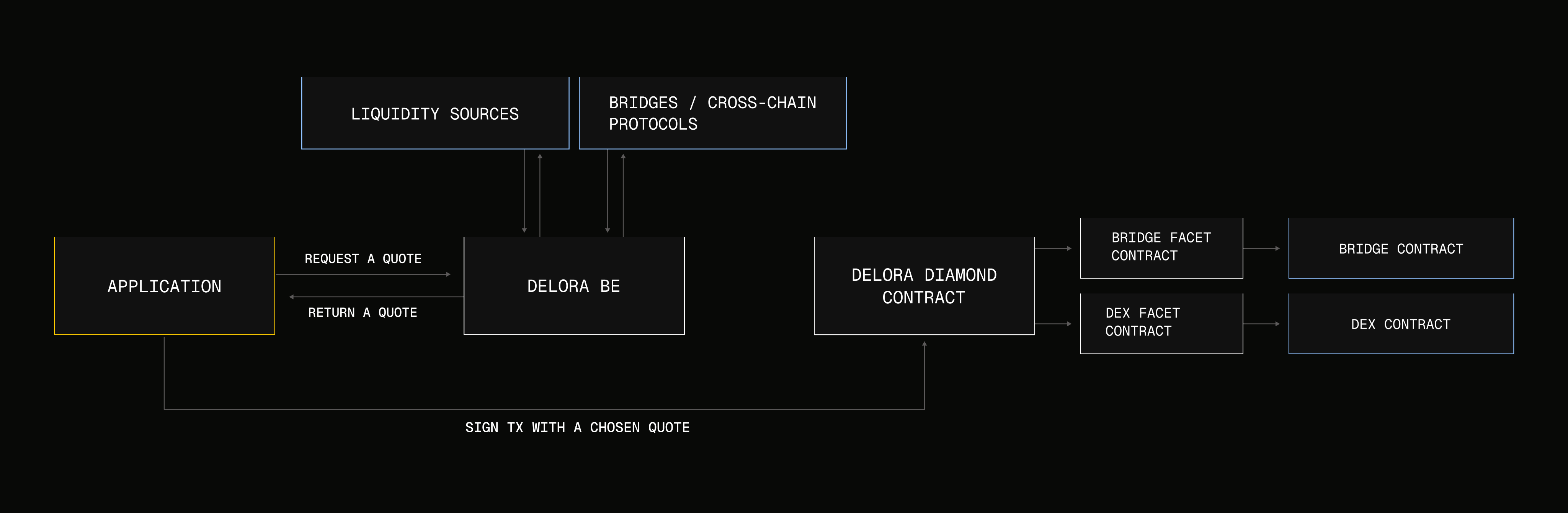
Key Components of Delora Architecture
1. dApp Integrations
What it is: The entry point where users interact. How it works: dApps plug into Delora’s API to request quotes for swaps or cross-chain transfers. Once the optimal path is chosen, Delora returns transaction payload data (calldata) for that route. The user or integrator wallet signs and broadcasts the blockchain transaction.
2. Delora Router (Off-chain Routing)
Purpose: The off-chain aggregation and routing layer. Functions:- Collect pricing and routes from integrated bridges and DEXs.
- Determine the optimal path based on cost, speed, and reliability.
- After identifying the optimal route, Delora validates it against supported adapters, encoded constraints, allowlists, and execution requirements before returning calldata.
- Encode the chosen route, constraints, fee logic, deadlines, and adapter-specific execution data into the returned payload.
3. Transaction Payload (Calldata)
Essence: Execution-ready transaction data that defines the selected route and constraints. Contents:- Full route across liquidity sources.
- Minimum output amounts and deadlines.
- Fee logic.
- Adapter-specific execution data.
4. Delora Diamond Contract (On-chain Executor)
Role: The primary smart contract entry point for execution. Functions:- Validate the encoded route data and transaction constraints.
- Route the transaction to the correct facet (bridge/DEX).
- Enforce constraints and trigger fallback if conditions are violated.
- Act as a deterministic state machine for all executions.
5. Delora Facet Contracts
Feature: Modular and extensible — new providers can be added without redeploying the system.- Bridge Facets: Connect to supported cross-chain bridges.
- GenericSwap Facet: Route same-chain swaps to the best available DEX.
6. Liquidity Provider Contracts
- Where settlement happens: Bridge or DEX contracts finalize the trade or transfer. Rule: Delora enforces encoded execution constraints before routing funds through supported adapters.
End-to-End Flow
- Request → The user starts a swap or transfer from a dApp integrated with Delora.
- Quote Discovery → Delora Router queries connected bridges and DEXs to gather pricing and route data.
- Payload Creation → The chosen route, constraints, fee logic, deadlines, and adapter-specific execution data are encoded into transaction payload data.
- Transaction Signature → The user or integrator wallet signs the blockchain transaction that contains the returned payload.
- On-chain Submission → The signed transaction is broadcast to the origin chain.
- Facet Dispatch → Delora Diamond validates the packet and forwards execution to the correct Facet Module (bridge or DEX).
- Settlement → The liquidity provider’s contract (bridge/DEX) finalizes the swap or transfer.
- Outcome → Execution completes if the encoded constraints and downstream adapter requirements are satisfied.
Key Differentiators
- Security-first: Routes are validated against supported adapters, encoded constraints, allowlists, and execution requirements.
- Unified integration: One API replaces dozens of fragmented setups.
- Determinism: Execution follows encoded constraints and fails when those constraints are not satisfied.
- Modularity: Extensible architecture with pluggable facets and providers.
- Efficiency: Faster go-to-market with lower maintenance overhead.